
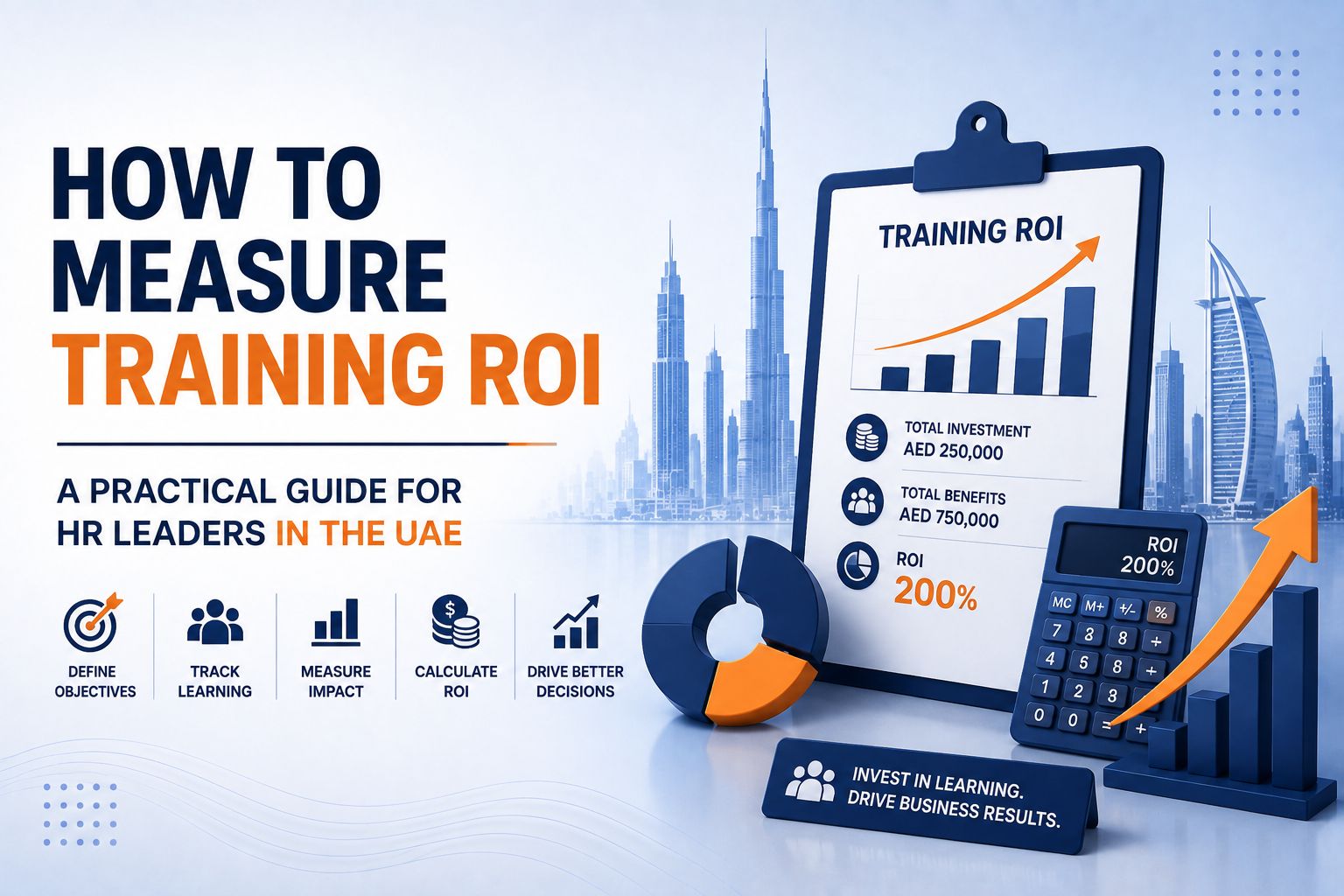
Your CFO wants numbers. Your L&D team wants recognition. Here is the exact framework — with a live ROI calculator and UAE-specific examples — to give both what they need.
AED 370B+
estimated global corporate training spend in 2025
Only 8%
of companies formally measure training ROI beyond Level 1
353%
average ROI reported by companies with structured L&D evaluation
In this guide
- Why measuring training ROI is now non-negotiable
- The Kirkpatrick Four-Level Model explained
- The Phillips ROI Methodology: adding the financial layer
- The ROI formula and how to use it
- Live training ROI calculator
- UAE-specific worked examples
- A step-by-step measurement plan for HR leaders
- Common mistakes and how to avoid them
- Pre/post-assessment checklist
Every quarter, HR and L&D teams across the UAE face the same uncomfortable conversation: a senior leader or CFO asks what the training budget actually delivered. Too often, the answer is a slide deck of attendance figures and participant satisfaction scores — metrics that communicate effort, not impact.
The consequence is predictable: training budgets get cut, L&D gets repositioned as a “nice-to-have,” and the function loses its seat at the strategic table. This doesn’t have to be your story.
Measuring training ROI is not as complicated as most HR leaders fear. It requires the right frameworks, the right data collection habits, and the willingness to connect learning outcomes to business results. This guide gives you all three.
Framework one
The Kirkpatrick Four-Level Model: your evaluation foundation
Developed by Donald Kirkpatrick in the 1950s and updated continuously since, the Kirkpatrick Model remains the most widely used framework for training evaluation in the world. Its enduring relevance comes from a simple insight: training creates value at four distinct levels, and most organizations only measure the first one.
1
Level 1 · Kirkpatrick
Reaction — did participants value the experience?
What it measures: Participant satisfaction, perceived relevance, and engagement with the training. How to measure it: Post-training surveys (the classic “happy sheet”), real-time pulse checks, Net Promoter Score-style single questions. UAE context: In a multicultural workforce, delivery style matters enormously. A program that feels culturally irrelevant will score poorly at Level 1 regardless of content quality. Limitation: A high satisfaction score does not mean learning occurred. Treat Level 1 as a signal, not a result.
2
Level 2 · Kirkpatrick
Learning — what knowledge and skills were actually acquired?
What it measures: The degree to which participants gained the intended knowledge, skills, attitudes, confidence, and commitment. How to measure it: Pre- and post-training assessments, skills demonstrations, knowledge quizzes, role-play observations, and simulations. UAE context: For compliance-heavy sectors (banking, healthcare, government), Level 2 data is often a regulatory requirement — not just an L&D nicety. Key principle: Always run a pre-assessment before training begins. Without a baseline, you cannot demonstrate that improvement occurred because of the training.
3
Level 3 · Kirkpatrick
Behavior — are people applying what they learned on the job?
What it measures: The extent to which participants apply new skills and behaviors in their actual roles, 30–90 days after training. How to measure it: Manager observation checklists, 360-degree feedback surveys, mystery shopper exercises (for customer-facing roles), CRM or system data (for sales training). UAE context: The largest behavioral gap in UAE organizations is typically between knowing what to do (Level 2) and actually doing it under pressure in a hierarchical or multicultural team context. Level 3 data reveals whether your organizational environment supports or suppresses behavior transfer. Critical insight: If Level 3 scores are low despite high Level 2 scores, the problem is not the training — it’s the environment. Managers may be inadvertently undermining new behaviors.
4
Level 4 · Kirkpatrick
Results — what business outcomes did the training produce?
What it measures: The degree to which targeted business outcomes occurred as a result of the training: revenue increase, productivity improvement, cost reduction, quality improvement, customer satisfaction, attrition reduction. How to measure it: Business KPI dashboards, HR analytics, sales performance data, customer satisfaction scores (CSAT/NPS), absenteeism records. UAE context: Common Level 4 metrics in UAE organizations include: employee retention rates (high attrition is a significant cost in the UAE due to visa-related hiring cycles), customer experience scores, compliance incident rates, and time-to-productivity for new hires. The challenge: Many factors affect business results simultaneously, making it hard to isolate training’s contribution. This is exactly what the Phillips Methodology addresses.
“The Kirkpatrick Model doesn’t just measure training — it measures the organization’s capacity to translate learning into results.”
Framework two
The Phillips ROI Methodology: adding the financial layer
While Kirkpatrick’s four levels give you a comprehensive picture of training effectiveness, they stop short of answering the CFO’s actual question: was the money worth spending? Jack Phillips addressed this limitation directly by adding a fifth level to the framework — a rigorous financial calculation of return on investment.
The Phillips Methodology also introduces a critical step that Kirkpatrick does not explicitly address: isolating the effects of training from other factors. In any organization, business results are influenced by market conditions, personnel changes, technology, management, and many other variables. Without isolation, you cannot credibly claim that training caused the improvement you’re observing.
5
Level 5 · Phillips addition
ROI — what was the financial return on the training investment?
What it measures: The net monetary benefit of the training program compared to its total cost, expressed as a percentage. The isolation step (what makes Phillips unique): Before calculating ROI, Phillips requires you to estimate what percentage of the measured business improvement is attributable to training versus other factors. This is typically done through participant self-assessment (“what percentage of this improvement do you attribute to the training?”), manager assessments, control group comparisons, or statistical analysis. Why this matters: Without isolation, a sales team that improves revenue by 20% after training might be benefiting from a market upturn, a new product launch, or a competitor’s failure. Claiming training caused the full 20% would be dishonest and, critically, unconvincing to experienced leaders.
The calculation
The training ROI formula
Training ROI (%) = [ (Net Program Benefits ÷ Program Costs) ] × 100
Net Program Benefits = Total monetary value of training outcomes − Total program cost
Total program cost includes: trainer fees, venue/technology, materials, participant time (salary cost during training hours), pre/post assessment administration, and any follow-up coaching costs.
Monetary value of outcomes includes: revenue generated, cost savings, time saved × hourly rate, attrition reduction savings, quality improvement savings, and any other quantifiable business metric influenced by training.
Try it yourself
Training ROI calculator
Enter your program figures below to calculate ROI instantly.
Training ROI calculator — Phillips Methodology
Total training cost (AED)
Measured business benefit (AED)
Attribution to training (%)
Calculate ROI
UAE worked examples
Three UAE training ROI examples — worked through
UAE example 1 · Dubai logistics firm
Management training for operations supervisors
A logistics company with 400 employees sent 25 supervisors through a 3-day management training program. Training cost: AED 85,000 (including facilitator, venue, and participant time). Within 90 days, measurable outcomes included: team absenteeism down 18% (AED 120,000 annualised value), error rate in warehouse operations down 12% (AED 95,000 cost saving), one grievance case avoided (estimated AED 45,000 HR/legal cost saving). Total measured benefit: AED 260,000. Participants estimated 65% attribution to training. Attributed benefit: AED 169,000. Net benefit: AED 84,000. Training ROI: 99% — the program paid for itself within the quarter.
UAE example 2 · Abu Dhabi financial services
Customer service excellence training — 60 branch staff
A regional bank trained 60 customer-facing employees in a blended customer experience program (2 days in-person + 4 weeks online reinforcement). Training cost: AED 110,000. Outcomes at 90 days: CSAT score moved from 71 to 83 (+12 points); churn rate among the trained team’s customer portfolio fell by 9%, representing AED 380,000 in retained revenue. Manager assessments estimated 55% training attribution. Attributed benefit: AED 209,000. Net benefit: AED 99,000. Training ROI: 90% — and climbing as behavioral change compounds over time.
UAE example 3 · Dubai retail group
Sales skills training — 40 store managers
A multi-brand retail group trained 40 store managers in advanced consultative selling and upselling techniques over 2 days. Training cost: AED 60,000. Within 60 days, average transaction value increased by 8.4% across trained stores vs. 1.1% in untrained control stores. The delta (7.3% incremental) generated AED 420,000 in additional revenue over the period. Attribution conservatively set at 70% (control group comparison). Attributed benefit: AED 294,000. Net benefit: AED 234,000. Training ROI: 390% — a clear, defensible case for expanding the program company-wide.
Implementation
Your step-by-step measurement plan
Follow this sequence before, during, and after every significant training program.
1
Define the business objective (before training design)
Identify the specific business KPI you want the training to move — not “improve leadership skills” but “reduce first-year manager attrition by 15% in 12 months.” This anchors your Level 4 measurement from the outset and ensures training design works backwards from outcomes.
2
Establish your baseline (before training begins)
Record current performance on all relevant KPIs: sales figures, error rates, satisfaction scores, attrition rates, productivity metrics. Run your pre-assessment. Without a baseline, you have nothing to compare against — and no way to prove
improvement occurred.
3
Administer Level 1 and Level 2 measurement (during/immediately after training)
Collect reaction data via survey within 24 hours of training completion. Run your post-assessment to measure knowledge gain. Calculate the learning delta (post-assessment score minus pre-assessment score) for each participant and cohort.
4
Measure behavior change at 30 and 60 days (Level 3)
Brief line managers with observation checklists. Conduct structured one-on-ones or 360-degree surveys. Identify which new behaviors are being applied and — critically — which are not, and why. Feed findings back into the reinforcement plan.
5
Measure business results at 90 days (Level 4)
Pull the KPI data you baselined in step 2. Calculate the improvement. Where possible, compare against a control group that did not receive training. Collect participant self-assessments of attribution percentage.
6
Calculate and report ROI (Level 5 — Phillips)
Apply the ROI formula. Prepare a one-page ROI summary for leadership: cost of program, measured business benefit, attribution percentage, net benefit, and ROI percentage. Include qualitative data (participant quotes, manager observations) to give the numbers human context.
Common pitfalls
The four mistakes that invalidate training ROI data
Mistake 1: Skipping the pre-assessment. Without a baseline score, your post-training improvement data is meaningless. You cannot prove a gap closed if you never measured it. Make pre-assessment mandatory — even a 5-minute knowledge check is sufficient for most programs.
Mistake 2: Claiming 100% attribution. No training program causes 100% of a business improvement. Claiming it does destroys your credibility with CFOs and operations leaders. Even conservative attribution estimates (50–70%) produce compelling ROI numbers — and they’re honest.
Mistake 3: Measuring too soon. Behavior change takes time. Measuring Level 3 one week after training captures nothing meaningful. The minimum window is 30 days; 60–90 days is the standard for most programs. Leadership programs may require 6-month measurement windows.
Mistake 4: Reporting only numbers. Pure ROI percentages mean little to non-finance leaders. Always pair your ROI calculation with the story behind the numbers — which teams improved, what behaviors changed, what challenges remain, and what the data recommends for the next program cycle.
Pre/post checklist
Pre/post assessment implementation checklist
Business KPIs identified and baselined before training begins
Pre-training knowledge assessment administered to all participants
Control group identified (even informally) to support attribution
Line managers briefed on expected behaviors and observation checklist
Post-training assessment administered within 24 hours of completion
Level 1 satisfaction survey sent within 24 hours
30-day behavior follow-up scheduled in manager calendars
60-day KPI data pull scheduled in HR analytics calendar
90-day ROI calculation and leadership report scheduled
Findings fed back into next training cycle design
Let Ethikcorp build your training measurement framework
Every Ethikcorp corporate training program includes pre-assessments, structured post-training evaluation, and a 90-day impact report — so you always have the data to justify your investment to leadership.