
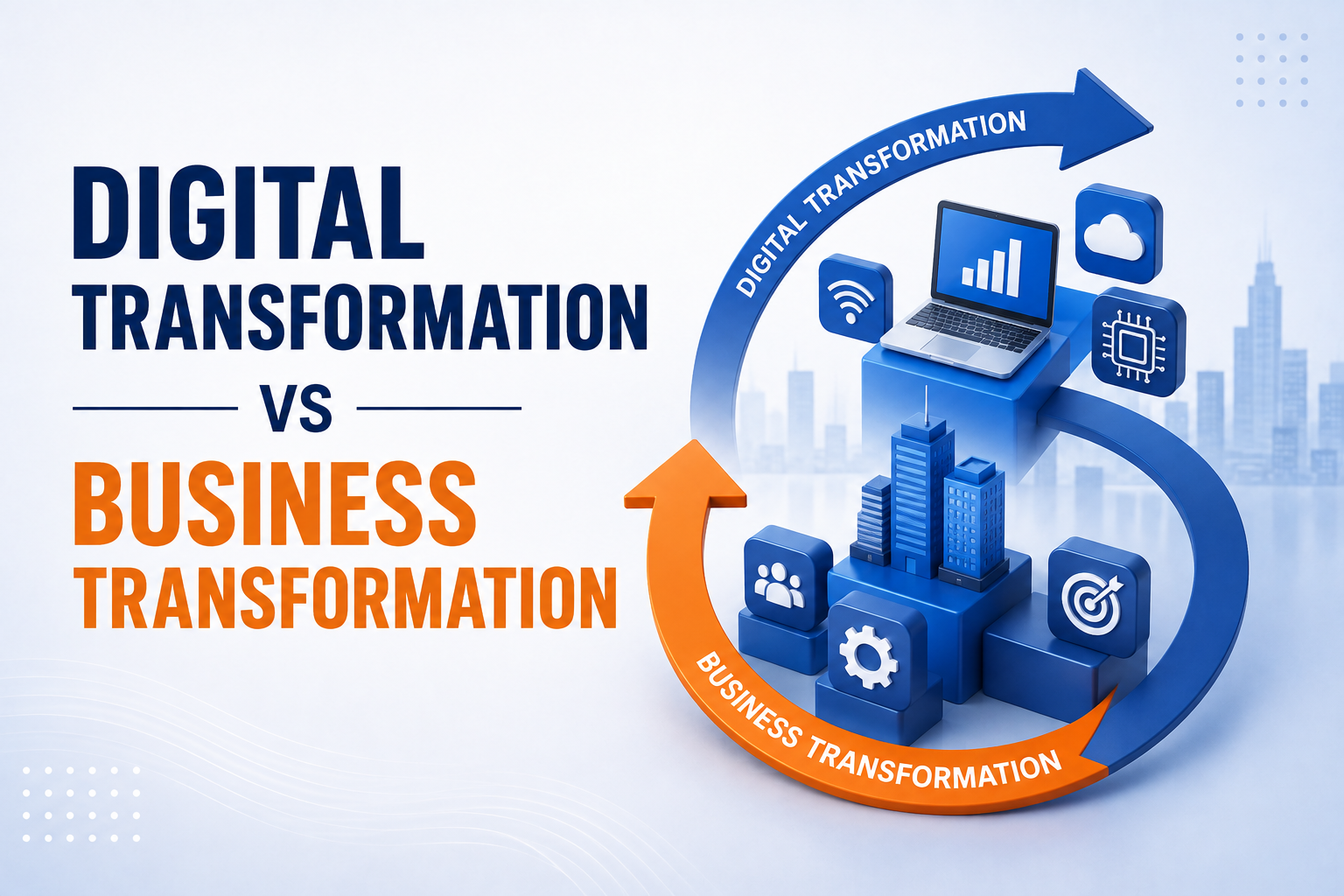
Every boardroom conversation today eventually circles back to one of two terms: digital transformation or business transformation. Leaders use them interchangeably. Consultants debate their nuances. And organizations pour millions into chasing both, often without a clear sense of where one ends and the other begins.
That confusion is expensive. Companies that treat these two as the same thing tend to over-invest in technology while under-investing in the cultural and strategic shifts that make change actually stick. So let’s clear it up plainly and practically.
So, What Exactly Is Business Transformation?
Business transformation is the work of fundamentally rethinking how an organization creates value, for its customers, its people, and its stakeholders. It touches strategy, structure, culture, processes, and the people who carry them out. Understanding what the business transformation process truly means requires recognizing that it goes well beyond installing new software or automating a workflow.
A genuine business transformation might mean redefining your entire business model, entering new markets, restructuring leadership, or overhauling the customer experience from scratch. It forces organizations to answer harder questions: Why do we exist? Who do we serve? How do we compete and why should anyone choose us?
This is precisely why business transformation is important. Without it, even the most technologically advanced organization risks digitizing a broken model, faster, yes, but still broken.
At Ethikcorp, we work with organizations to drive exactly this kind of deep, strategic change, aligning people, processes, and purpose before technology ever enters the conversation.
And What Does Digital Transformation Actually Mean?
Digital business transformation, by definition, refers to the integration of digital technology across every area of a business fundamentally changing how operations run and how value reaches customers. It spans cloud migration, data analytics, AI adoption, automation, and the redesign of customer-facing platforms.
Corporate digital transformation is not simply an IT initiative. It reframes the digital transformation business model by using technology as a lever, to create new revenue streams, sharpen efficiency, and respond to market shifts before competitors do. Think of it as the how: the tools, platforms, and digital processes that help a transformed organization execute at scale.
The digital transformation business process layer is where IT and operations teams typically focus automating manual tasks, integrating disconnected systems, and using real-time data to make smarter decisions, faster.
What’s the Real Difference Between the Two?
Here’s the simplest way to frame it:
Business transformation is strategic. Digital transformation is instrumental.
Business transformation and technology are deeply linked, but they are not the same thing. You can digitize every process in your organization and still fail to transform, if the underlying strategy, culture, and value proposition remain untouched.
Equally, launching a bold new strategy without the right business transformation technology to support it leads to the same dead end. Strategy without execution infrastructure collapses under its own weight.
The most effective organizations understand that IT and digital transformation must serve a broader organizational vision, not drive it. Technology is the accelerator. The direction has to come from leadership.
| Business Transformation | Digital Transformation | |
| Focus | Strategy, culture, people, model | Technology, processes, data, systems |
| Scope | Enterprise-wide, long-term | Often department or process-level |
| Driver | Market disruption, growth ambition | Efficiency, speed, digital capability |
| Outcome | New value creation, competitive repositioning | Operational agility, digital customer experience |
Do You Really Need Both- or Can You Pick One?
Treating these as an either/or choice is a strategic mistake. The real competitive edge comes from a synchronized digital business transformation strategy, one that uses technology to enable and amplify a fundamentally better business.
Here’s why business and digital transformation must move together:
- Strategy without technology stalls. An organization determined to become customer-centric but lacking the CRM systems, data infrastructure, or digital service channels to back it up will struggle to execute that vision at any meaningful scale.
- Technology without strategy drifts. IT business transformation projects that start with tools rather than business objectives, routinely run over budget and under-deliver. Research consistently shows that roughly 70% of transformation efforts fail, most often because the human and strategic dimensions were treated as secondary.
- Culture is the glue. People adopt new technology far more readily when they understand the why behind it. Business technology transformation succeeds when change management, workforce training, and leadership alignment are built into the process from day one, not added as an afterthought.
This is exactly where business digital transformation services play a critical role. Firms like Ethikcorp bridge the gap between strategy and execution helping leadership define the destination, build the roadmap, and prepare their teams to make the journey with confidence.
How Do You Build a Digital Business Transformation Strategy That Actually Works?
Whether you’re a mid-sized enterprise in the Gulf region or a global corporation, the fundamentals of effective technology business transformation stay remarkably consistent:
- Start with the business problem, not the technology. Ask what outcomes you need, stronger customer retention, faster product delivery, lower operational costs, before selecting any tools or platforms.
- Align leadership before anything else. Both digital and business transformations fail most often when C-suite alignment is missing. Transformation is, above all else, a leadership discipline.
- Design for people, not just processes. Invest in corporate training to ensure your workforce has the capability to thrive in the new operating model. Technology without human capability is simply expensive hardware.
- Measure what actually matters. Set KPIs that connect technology investments to real business outcomes, not just system adoption rates, but revenue impact, customer satisfaction scores, and operational efficiency gains.
- Treat it as continuous, not a project. The most effective digital business transformation services approach change as an ongoing discipline, not a one-time implementation with a go-live date and a wrap party.
Where Does This Leave Your Organization?
Digital transformation vs. business transformation is not a competition, it’s a conversation that every serious leader needs to be having right now. The strongest organizations are asking both questions simultaneously: What must change about how we operate? And what must change about who we are and where we’re headed?
Getting that balance right is the defining challenge of modern enterprise leadership. It demands clear strategy, the right partners, and a workforce ready to evolve alongside the business.
At Ethikcorp, we help organizations navigate both dimensions from strategic repositioning and business model redesign to the operational and digital shifts that bring transformation to life. Explore our Business Transformation services or visit our Insights blog to see how organizations like yours are building tomorrow’s advantage today.
Ready to transform — strategically and digitally? Connect with Ethikcorp and let’s map your path forward together.